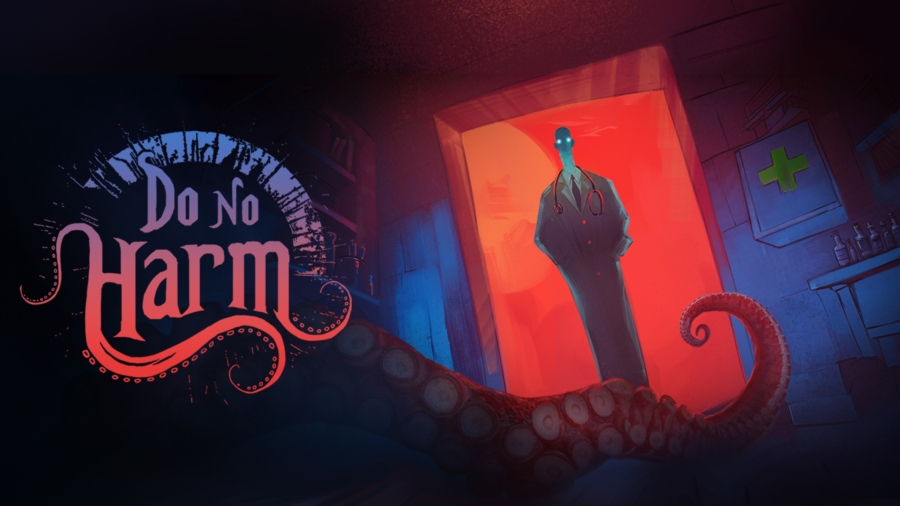
Do No Harm Spiel
There are many games that claim to be the spiritual successor to Papers, Please. Plenty have already tried incorporating Lovecraft, or cosmic horror creeping into otherwise sane jobs. Do No Harm is a Lovecraftian doctor simulator. I’ve played apothecary simulators and surgeon simulators, but a doctor simulator in eldritch horror is one I hadn’t tried.
You play as the village doctor who just moved into town. Patients arrive with symptoms. Diagnose them and administer the injection. The medicine seems to be inspired by medieval humorism, which the game renders as four “liquids”. The job is to inject the right amount of liquid to balance the patient’s wellbeing. Mistakes carry no immediate consequences, however. You can be wrong, repeatedly, with very little repercussion. Your actions are all considered good so long as the patients can leave good reviews. It may be based on the reality of the medical industry, but it doesn’t have enough pull to introduce other elements of the game.
In Papers, Please, the game did not simply run on a single job. The protagonist’s apparent role, an immigration inspector, kept the booth part of the game rolling. In the overarching narrative, however, he was playing a latent role: a bureaucrat nudged into a position of power. It enabled him to make decisions within his own realm of a border checkpoint. Do No Harm lacks that dichotomy. Villagers turn up asking the doctor to do their otherwise unethical bidding, and any self-respecting physician would decline and leave. The role our doctor plays is closer to the protagonist of Return of the Obra Dinn — one who certainly interacts with the world he is in, just not the people he is investigating. Our good doctor, while treating the town’s folk, is not part of the world.
That imbalance seeps through into the narrative. Our protagonist is bound by the title of the game to “do no harm” — so why is he perfectly willing to do harm? He accepts concoctions from strangers and administers them to himself and his patients. His Hippocratic oath goes out the window when a villager asks it of him. The game’s own dialogue admits the problem point blank: a character will say out loud that a physician has no business doing this. All of it lands within the first few days — not the full thirty. The game reveals its plan early, then spends the rest of the calendar going nowhere with it.
Conclusion: Obra Dinn Behind a Desk
Do No Harm takes the quirk of Papers, Please and runs it through a unique stylistic interpretation of Lovecraftian mythos. But I would argue the game leans closer to Return of the Obra Dinn. Behind the desk, there is no ship and no room to investigate — only a protagonist that is not fully established. While the different take on an established sub-genre is interesting in its own merit, at the price point of $15.99, I believe it will be a hard pill to swallow for many.