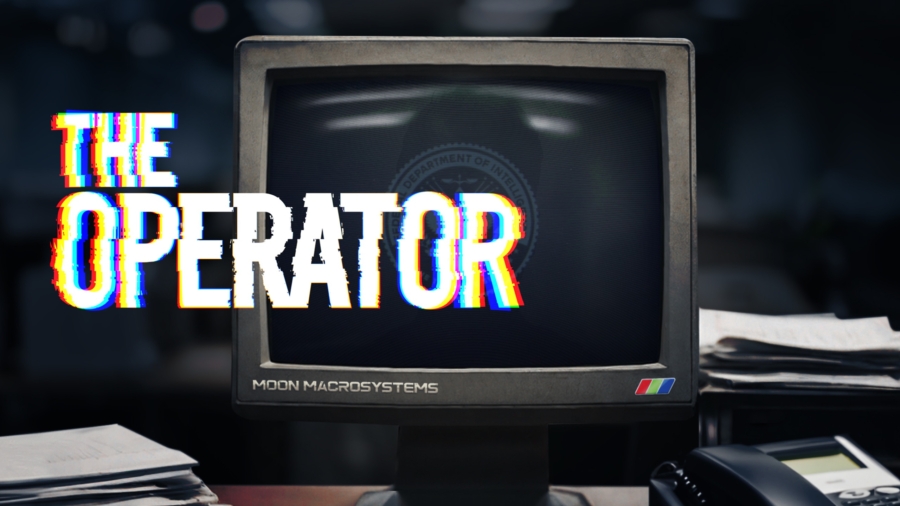
The Operator Spiel
As a fan of Orwell series, a similar game released in 2016, The Operator immediately had my fullest attention with its retro take on agent-handler system. The retro futurism from the 90s was wild, and the game does not shy away from it. The media thought ancient computer systems hooked up to a CRT monitor could handle nation-wide surveillance and advanced softwares to zoom in beyond the tinest pixels.
The premise of The Operator is rather simple. In an X-Files FBI-like organization, you are tasked to help agents working in the field as an operator, more or less what we would call “handler” in a spy movie. A player has access to different tools via the terminal. It is heavily implied FDI, the in-game FBI equivalent, is running compartmentalized bureaucracy: agents only have access to the crime scene, operators only have access to what is available in the headquarter, and the supervisors are the ones connecting the calls. But to put it simply, it means you need to do some work before you can get the files or evidences for the agent on the other end of the call.
Gameplay wise, it is as much as what you would expect from a retro futuristic crime investigation set in the 90s — screaming “enhance” but in X-Files tone make it happen. It doesn’t explain how the lab equipments, let alone how the evidences submitted and stored in FDI, can be accessed completely remotely. What it does enable, however, is the opportunity for the operator, the protagonist, to shine. The player has to decide what evidence to focus on and analyzed, that is, if the narrative did not railroad the game straight to the main plot.
The Operator is unfortunately too linear for its own system. It creates an illusion of choice. All the bells and whistles are only used once. The game’s shortcoming seems to stem from its heavy reliance on the narrative, which also happens to rely on lack of agency. Perhaps the overarching plot wanted to follow the flavor of hardboiled fictions, but I would be more sympathetic if either the suffering characters developed enough of their own arcs, or the corrupted systems therein are convincingly concrete. Neither the character nor the antagonists particularly have finished forming shapes of their own.
Conclusions: 3 Hours of Intro
I’ve finished my playthrough in roughly 3 hours, if I am being generous. I didn’t finish it all in one sitting, which happened to reload the game from the beginning of each day. I suspect for majority of the players, it might even be shorter than 2 hours return window. The Operator has promises; it carries the torch of specific style — puzzle game likes Papers, Please and Orwell. But it falls short as it fails to establish its own FDI running in the world of The Operator. No cases were spared to build the world. And they were all centric to the overarching plot. It needs more plain experience to bring out the spices. Perhaps the sequel that is in the work would finally show what the world of The Operator has to fully offer, but until then, I would reserve the game for those who want the experience of the type of the puzzle it offers.