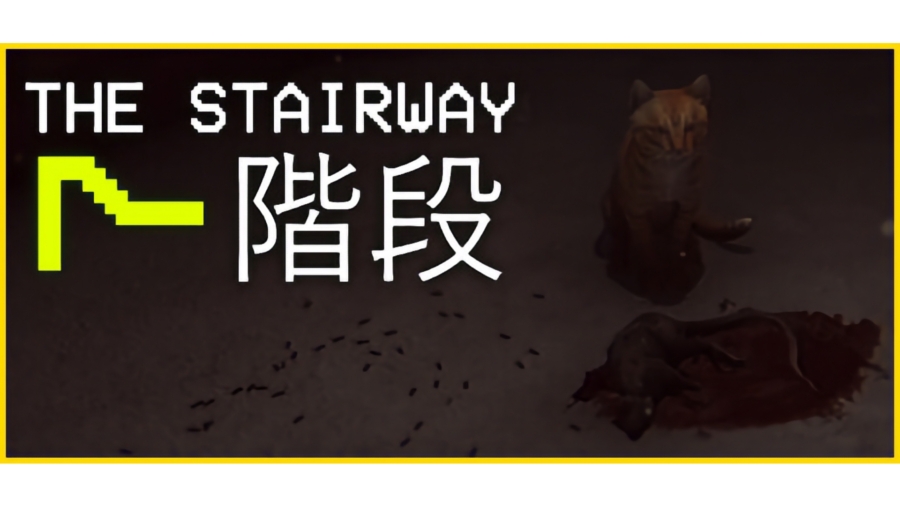
The Stairway 7 Spiel
Different Exit 8-likes certainly have tried different methods of incorporating or developing the definition of “Exit 8.” I even wrote about the four pillars of Exit 8-likes. Unfortunately The Stairway 7 misses the mark in its own noise, enough that I wonder if the game was even meant to be an Exit 8-like.
The Stairway 7 follows similar rules to most Exit 8-likes: examine the surroundings, turn back if there is an anomaly, or proceed if there is none. The game never specifies where it is set and becomes loose on its definition of the world. The core problem is inherent in its lack of concrete premise. It is both a stairway and a hallway for an apartment with an elevator. But it doesn’t have enough landings to sell it as a real place. In fact, most players would immediately notice a hanging bulb from the ceiling at the character’s eye level — suspiciously unreal, but must be accepted as normal.
The gameplay, built on this artificial world, is primarily a patchwork of different genres: jump scares, inventory and healing items, linear playthrough with limited randomness. In the original the Exit 8, upside down posters poked good fun at how eerily different a subway station can be. The Stairway 7 does the exact opposite — we cannot place where, or when, this is. So they exist. What for is lost. The jump scares aren’t really jump scares, because they happen repetitively. There is no real use of strategizing inventory, because the enemy only appears as a reprimand. The anomalies are linear, so much so that it becomes a walking sim. And the occasional frame drops during the climb tell me the small stage wasn’t a technical compromise either. Purpose is stripped away.
The true irony lives in the game’s sudden shift toward narrative. To put it bluntly, it doesn’t work. The game makes an attempt at psychological horror with symbolism, but it doesn’t do the heavy lifting of connecting the dots. The reveal hits like a train near the end of the stairway. Unlike other Exit 8-likes, the game has checkpoints. That is 70 stories worth of stairs to set up a plot, and it doesn’t use them until the very end.
Conclusion: Too Many Pitstops for Exit 8
What made The Exit 8 possible: simplicity. Its honest recreation of the Japanese subway system allowed players across the world to enjoy the eeriness naturally. Exit 8-likes don’t carry around extra subsystems, so a player may enjoy the space and atmosphere. The horror of Exit 8 comes not from the scary monster, but from the subverted expectation of its simple hyperrealistic recreation. The Stairway 7 takes too many pitstops: imperfect environment, borrowed gameplay elements, an Exit 8 mechanic that is not fully incorporated, and a story mixed in for good measure. For $8.99, it is a working Exit 8-like, but not much more.